


Waste recycling in the context of the circular economy: from production waste to animal feed and fertilizer for local smallholders
Agriculture in Kenya faces numerous challenges, especially for smallholder farmers who are often faced with high production costs: feed for chickens and fish accounts for up to 90% of these costs in many cases. Conventional feed is often expensive and is usually made from imported raw materials, resulting in additional transportation routes and potentially increasing procurement costs for smallholder farmers.
LIMBUA and Omnivore Recycling have launched a partnership to develop possible solutions to this problem and promote locally produced alternatives to soy, maize or fishmeal. By working together, we can directly address two critical needs of Kenyan smallholder farmers: the provision of affordable animal feed and organic fertilizer.
How does this work?
By utilizing organic waste from LIMBUA production through insect larvae from Omnivore Recycling's innovative system. The insect technology is able to recover nutrients and thus provides a source of protein for animal feed.
At the start of the pilot project, the Omnivore Recycling team visits us at our production site in Ena. They learn about the processes involved in avocado, mango and macadamia production and form teams to implement the first container system for waste recycling using insect larvae.
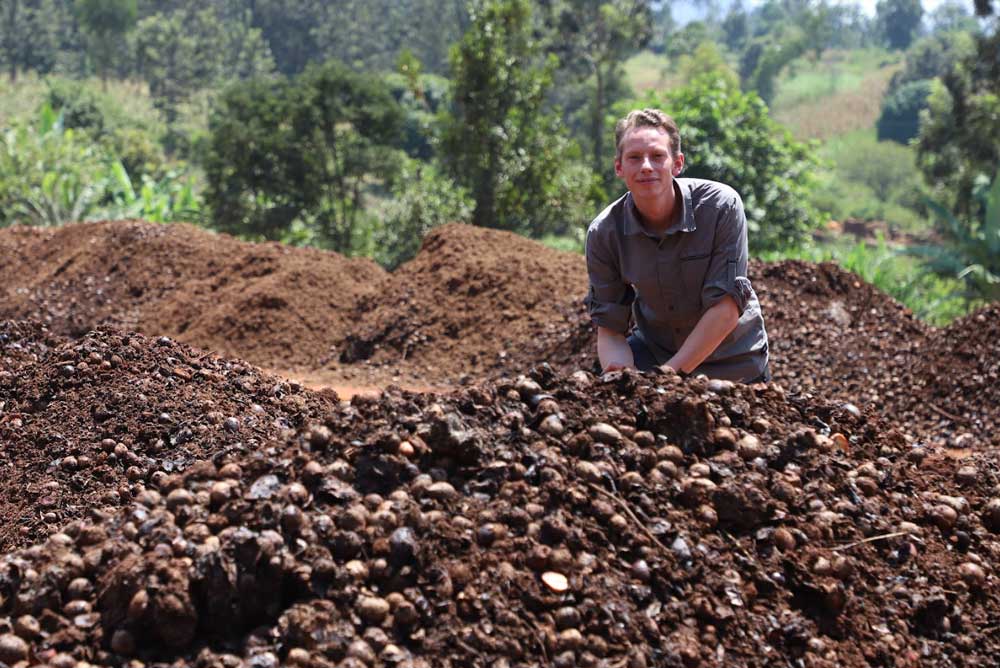
Marius Wenning, founder of Omnivore Recycling, inspects the LIMBUA organic compost – consisting of waste from avocado production, among other things
Risks of conventional animal feed production
The production of conventional animal feed can be associated with various ecological impacts depending on the raw material, its origin and the production method. Fishmeal is made from wild-caught fish and is an important source of protein in animal husbandry, particularly in aquaculture.
Depending on its origin and the fishing method used, the production of fishmeal can contribute to the use of wild fish stocks. Greenhouse gas emissions also arise from fishing, processing and transportation.
Depending on the growing region and production method, the cultivation of soy and maize for animal feed can be associated with land-use changes, soil degradation and the use of pesticides and fertilizers. Therefore, the use of Omnivore Recycling technology in combination with biological waste can represent an innovative problem-solving strategy.
Waste recycling of production waste: a further step towards a circular economy
At LIMBUA, we have been committed to the use of our resources from the very beginning. While much of our production waste is already converted into organic compost for the smallholder farmers, the partnership with Omnivore Recycling offers an additional dimension to waste management: by processing our organic waste, consisting of leftovers from organic avocado, macadamia and mango production, we are creating a new way to utilize these resources.
The waste is processed in a scalable container system from Omnivore Recycling, where each unit is equipped with insect larvae and can convert up to 1 ton of organic production waste per day. Over the course of the project, one of these container systems will be installed at our production site in Ena, with additional units added as needed to increase capacity.
Selected organic production residues are used as raw materials for animal feed and fertilizer. This creates cycles between processing activities and agricultural farms.
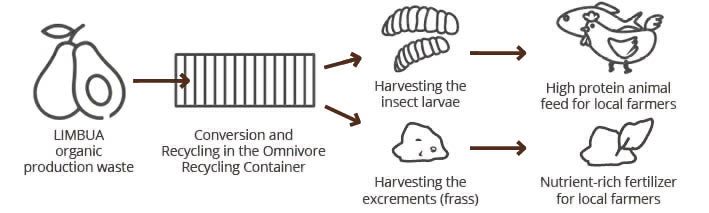
Conversion of organic waste into animal feed and fertilizer for smallholder farmers
From waste to resource: conversion of organic production waste into animal feed and fertilizer
The partnership with Omnivore Recycling is based on a multi-stage process that focuses on the larvae of the black soldier fly (BSF) as the main actor. These are the main steps:
Installation of the container system: Omnivore Recycling first installs a specialized container as a pilot project at our production site in Ena. This system can process up to 1 ton of organic waste per day and can be scaled up by adding more containers to increase capacity if needed.
Feeding the organic waste: The leftovers from LIMBUA production are added to the container as a mixture, where they serve as food for the larvae of the black soldier fly. The larvae consume the organic material and convert it into protein-rich biomass as they grow.
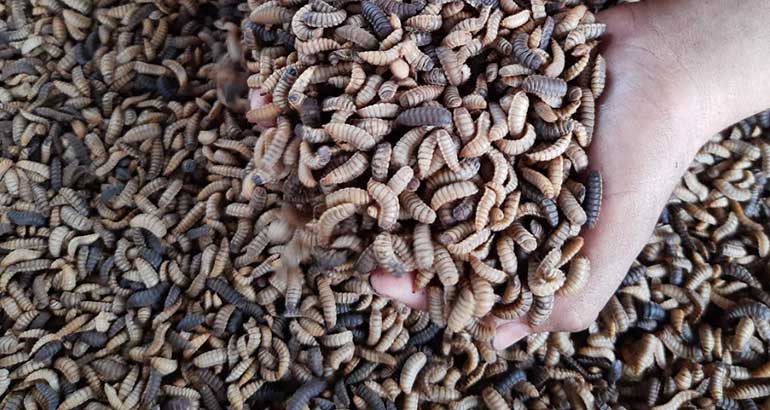
Black soldier fly (BSF) larvae – not only chickens appreciate this source of protein
Harvesting the end products: According to Omnivore Recycling, the harvested larvae have a protein content of 40–50%. The protein-rich larvae are used as feed for chickens and fish and provide a locally produced alternative to conventional protein sources. In addition, frass, a nutrient-rich fertilizer, is produced from the larvae's excrement, which can either be used directly in agriculture or mixed with compost to further increase the nutrient content.
End products for animal husbandry and crop production
The process produces two end products for agricultural use: protein-rich insect feed and BSF fertilizer. The BSF fertilizer provides organic matter and nutrients for agricultural soils, while the protein-rich insect feed can be used as a locally produced alternative to conventional feed.
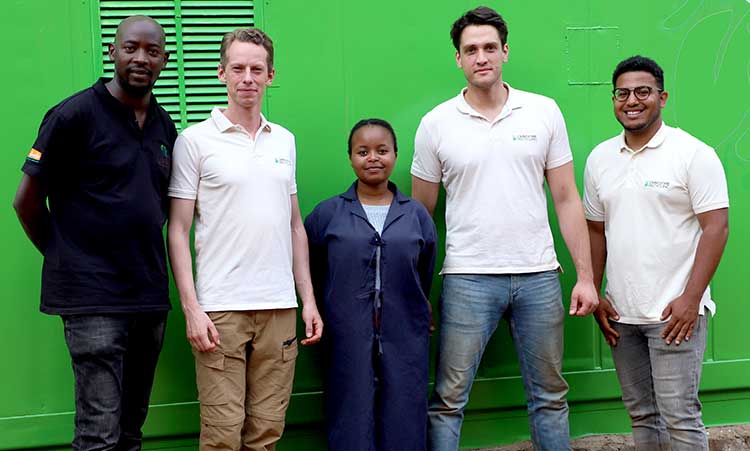
A team of LIMBUA employees supports the Omnivore Recycling Team in implementing the container system
Insect protein pilot project – what happens now?
For LIMBUA, this partnership represents an important diversification of our waste management strategies. By working with Omnivore Recycling, we are continuing to direct additional organic production residues towards agricultural use and process them into animal feed and fertilizer. This innovative solution shows how the circular economy can be put into practice and offers a model that could be of interest to other companies and regions.
In the coming weeks, we will monitor the progress of the project and provide initial insights into the recycling of organic production residues as well as the production and use of BSF fertilizer. We look forward to sharing more insights from the journey and providing further updates on the next developments and results of this pilot project.


