


Quality Assurance Across the Entire Supply Chain
At LIMBUA, fresh mangoes sourced through partnerships with contracted smallholder farmers are processed into dried organic mangoes at our own production facilities. As mangoes are a sensitive natural product, decisions made during harvesting, handling and transport have a direct impact on processing, yield and product safety. Mistakes at these early stages are difficult to correct later. For this reason, the training considers all process steps as one interconnected supply chain — from harvest and procurement to transport, production, packaging and export.
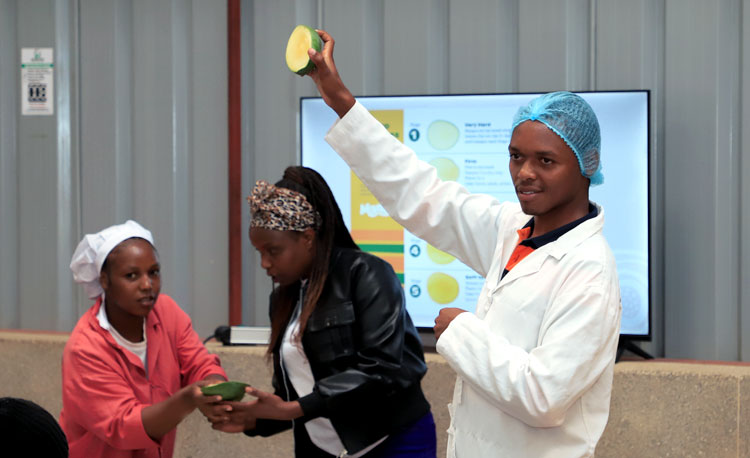
Practical Training: Teaching Harvest, Ripeness and Quality Criteria Directly on the Fruit
Objectives and Structure of the Mango Training
The training involves employees from agronomy, harvesting, procurement, quality management and food safety, as well as from production. Our field managers, who work closely with smallholder farmers and have in-depth knowledge of individual farms and harvesting conditions, are also actively involved. The aim is to create a shared understanding of requirements, responsibilities and interfaces between the different departments.
The training follows clear objectives. It is designed to:
- support consistent raw mango quality
- reduce post-harvest and processing losses
- equip employees with the necessary technical knowledge for their respective roles so they can perform their tasks safely and effectively
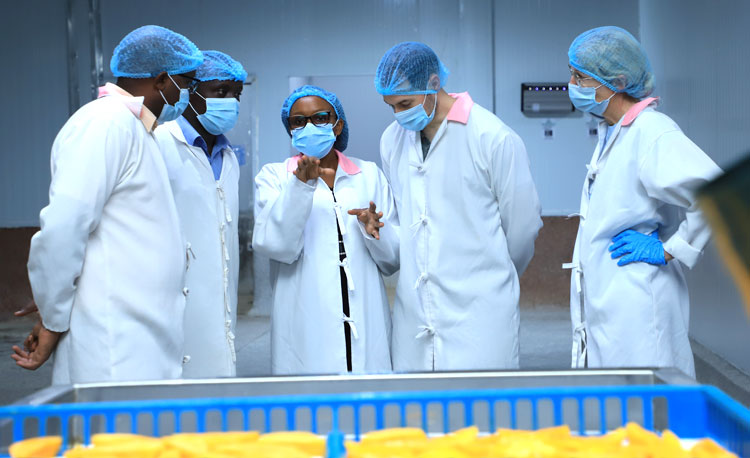
Uniform standards in mango production as the basis for B2B customer requirements
Training Content Along the Process Chain
The training content is closely aligned with the actual processes of mango handling and processing. Topics include harvesting methods, ripeness and quality indicators, and the proper handling of harvested mangoes. Another focus is placed on safe transport, correct vehicle loading, and the prevention of damage and contamination.
Within production, quality and food safety requirements are addressed across all processing steps. These include incoming goods inspections, ripening and sorting, drying, further processing, packaging and preparation for export. Sampling procedures, sensory evaluations, hygiene measures and compliance with defined process parameters are integral components of the training.

LIMBUA field managers during training, integrating quality requirements early into their work with smallholder farmers.
What Responsible Organic Mango Production Means
As an organic mango producer, careful handling of raw materials at LIMBUA is an important part of responsible organic mango production. Every mango that is harvested, transported and processed correctly helps to avoid losses and make better use of harvested raw materials. Consistent raw material quality reduces waste, lowers post-harvest losses and supports the use of the harvest from smallholder farmers in production.
This approach also creates reliability for our B2B customers. Documented controls and end-to-end traceability support product safety and consistent product quality. Traceability is therefore a core element of the mango training: employees are trained to correctly record and verify relevant data within the traceability process, so that origin, processing and allocation of the final dried mango products remain traceable throughout the process. Our internal training thus forms a central foundation for controlled organic mango processing.
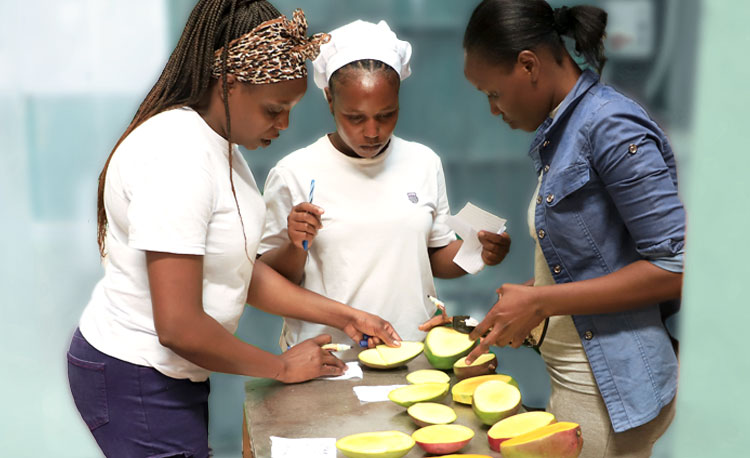
Training on the Reliable Identification of Ripeness and Quality Levels


