


As Co-Head of the Section for Agriculture at the Goetheanum in Dornach, Switzerland, Ueli Hurter supports initiatives and farms around the world in the further development of biodynamic agriculture. This year, Ueli visited LIMBUA in Kenya for the first time. During his stay, he worked closely with the Field Team, which is responsible for implementing biodynamic practices. The program also included visits to several farms run by smallholder farmers who are already working according to Demeter standards.
Ueli, this was your first visit to LIMBUA in Kenya. What was it like for you?
Ueli: "Before I arrived, I did not really know what to expect. And in the end, it was genuinely surprising. The welcome was open and festive. It was not simply a matter of arriving somewhere; I was truly received with warmth.
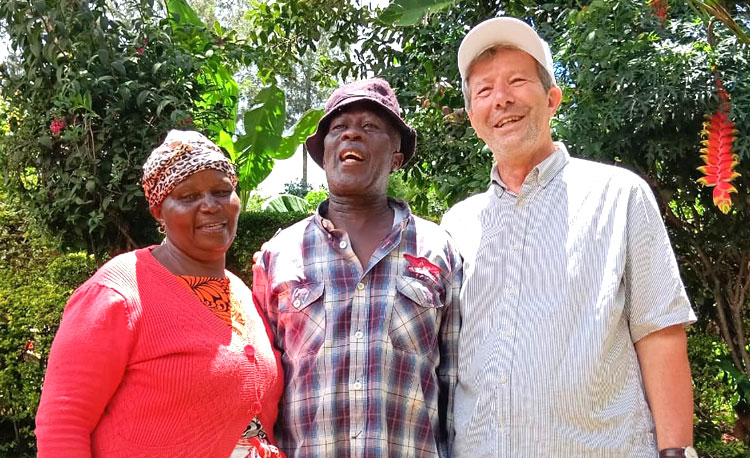
Ueli Hurter with Lizzie Njoki and her husband Douglas Nguu during his visit to LIMBUA in Kenya
That feeling of being welcome continued throughout the entire stay. You notice quite quickly that there is something special there; I would even say a certain spirit. This 'LIMBUA Spirit' can be felt throughout the company: from the first encounter with the driver who picked me up, to the teams, and all the way to management. That really impressed me. I had a certain picture in my mind, but the quality of the encounters was stronger than I had expected."
What stood out to you about the people you met?
Ueli: "What struck me was this: the people are present. Truly present. You have a real counterpart in front of you. I experienced both the smallholder farmers and the team as fully engaged. There was also a certain pride, not in the sense of separation, but rather in the sense of: 'I stand by what I do.' Very authentic.
With the farmers, the interaction was collegial and appreciative, based on mutual respect. There are major differences between Swiss and Kenyan agriculture. And yet, as farmers, we were immediately on the same wavelength. You sense a similar attitude and many shared aspects. At the same time, there is an openness that cannot be taken for granted. I felt that there were different layers of appreciation. Not only on a functional level, as in 'you do your work well', but also a genuine sense of dignity in the way people relate to one another."
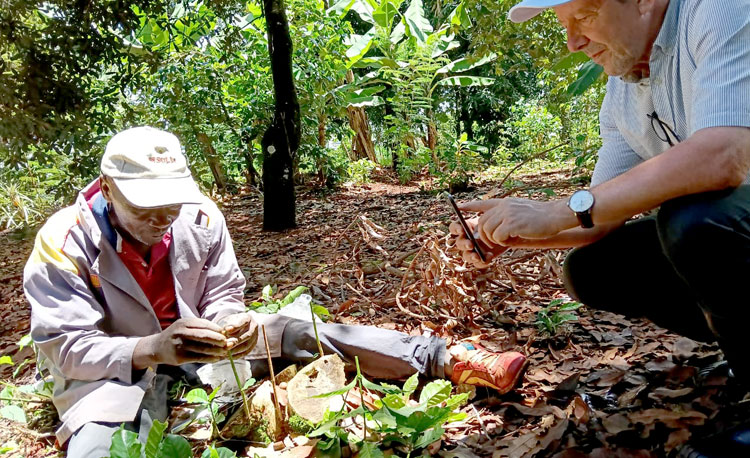
Learning from each other: African and European agriculture in comparison
You worked with the LIMBUA Field Team?
Ueli: "Yes, that was a very central part for me. We did not just talk; we worked together intensively. I have a lot of practical farming experience from my own background and was able to get involved hands-on, which in turn inspired the team. Among other things, we produced and applied preparations* and exchanged ideas about what works and where questions remain.
*Biodynamic preparations are made from plant, mineral and animal-based components. Depending on the type, they are added to compost or applied to fields and plants. They are intended to support soil fertility and natural development processes.
And it was not a one-way process. I contributed my knowledge, but I also learned from the Kenyans. The team is very well trained. You can tell that over the years, a great deal of experience in biodynamic agriculture has already been built up. At the same time, it is not rigid, but open. There is no attitude of 'we know this now', but rather: 'we are in a process.' And that is exactly how it has to be. Biodynamic agriculture is not something that can simply be transferred. It develops within its specific context."
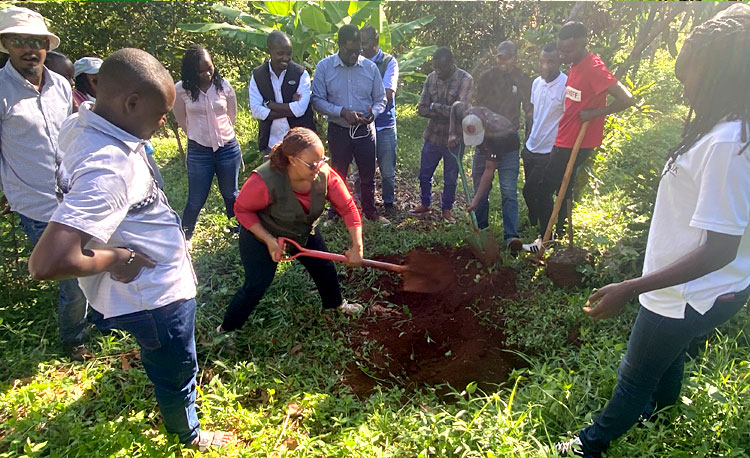
Practical collaboration with the LIMBUA Agricultural Team
You also visited farms. What was that like for you?
Ueli: "It was the first time I had seen mixed farms in an agroforestry system in this form. Among LIMBUA smallholder farmers, there is no specialization in just one crop. In addition to macadamia, they grow mangoes, maize, bananas, coffee and other crops; so there is great diversity. And the trees are integrated into the agricultural system. This is very different from Switzerland or Germany, for example, where there is a clear separation between trees and cultivated fields.
And it is not simply about having 'more plants' growing in one area; everything has a function. Harvest cycles are spread across the year, which makes the farm systems more stable.
For biodynamic agriculture, this is a good starting point. It is not about optimizing a single crop, but about understanding the interplay. We understand the farm organism as something living and multi-layered, in which everything is interdependent."
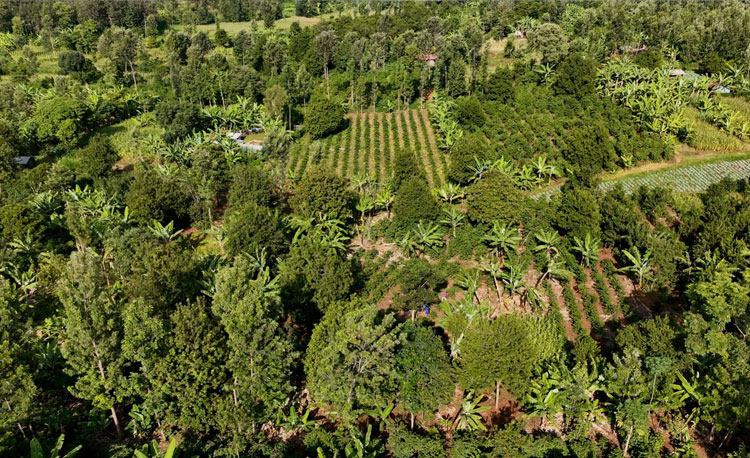
The agroforestry systems of LIMBUA smallholder farmers combine trees, crops and agricultural use on the same land
You visited Demeter-certified farmers. What did you observe there?
Ueli: "Yes, that was interesting because you could see different stages of development; from smallholder farmers who are still at the beginning, to those who already have several years of experience in biodynamic agriculture. And what is really interesting are the processes. Biodynamic agriculture cannot be assessed at a single moment in time. It develops over time.
The combination of agroforestry and biodynamics works well, partly because mechanization is low and because there is a great deal of flexibility in how each individual farm is designed and managed. There are indications that the resilience of the farms is improving and that this could also have a positive effect on product quality. This is exactly why we would like to examine these developments more closely in the future. Not only from an agronomic perspective, but also together with the farmers themselves.
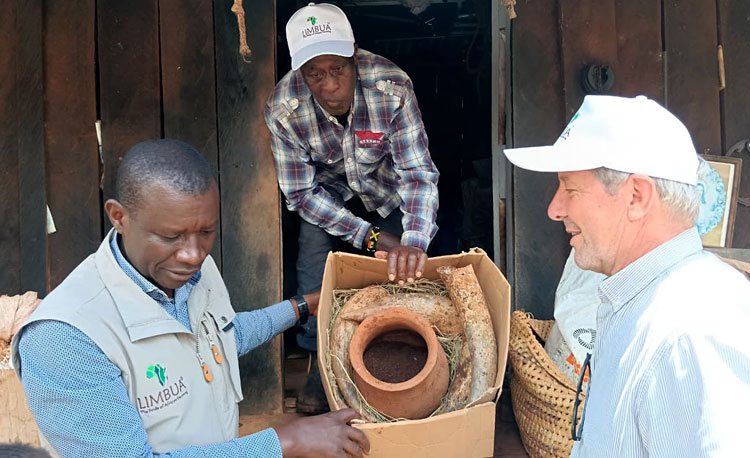
Insight into the production and application of biodynamic preparations in a smallholder context
Since the introduction of Demeter in 2018, an independent movement seems to have developed among LIMBUA smallholder farmers. More and more of them would like to implement biodynamic agriculture on their farms; for example, because of the positive feedback they hear from their neighbours. I see clear potential in this.
That is why it would be very interesting to examine the impact of biodynamics more closely and to ask: What changes in the plants? What changes in the soil? And also: What changes in people? For us, this is not only about measured values, but also about the experiences of the farmers themselves. Together with my team in practice-based research, I would like to develop a clearer picture within the framework of an Action Research project, actively involving the farmers. Together with the Kenyan team, we would like to bring together observations, interviews and agronomic assessments and learn from them."
What was it like to experience the harvest purchasing process?
Ueli: "Seeing that was very important for me. The harvests are purchased by the LIMBUA teams directly from the farmers on their farms and supported by a digital system. So, digitalization right in the middle of nature.
But for me, the decisive point is not only the technology, but the relationship. The purchasing process is not simply a market transaction; it has something of associative economics. This means that economic processes are not seen in isolation, but understood through relationships. LIMBUA is in direct contact with the farmers throughout the year. It is a relationship between the smallholder farmers and the company that has grown over time."
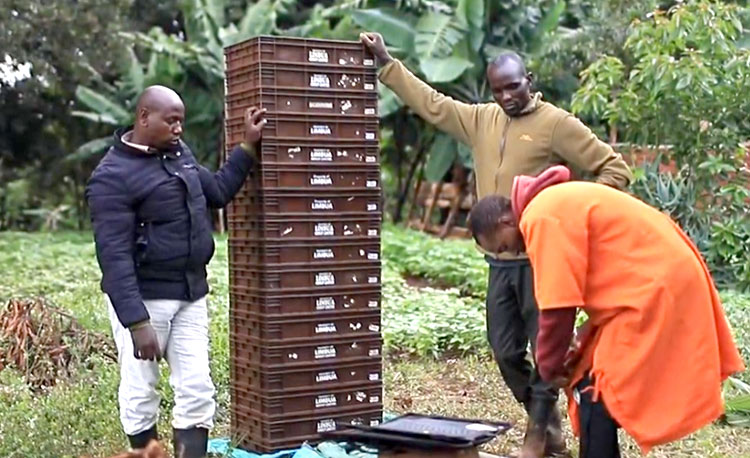
Harvest purchasing takes place directly on the farms and is recorded digitally
What agricultural differences do you see between Europe and what you experienced at LIMBUA in Kenya?
Ueli: "The starting point is different. In Europe, many things are more strongly separated: forest here, cultivated land there, livestock somewhere else. On the organic mixed farms in Kenya, everything is much closer together. Plants and animals are integrated into the system and are not viewed in isolation.
I believe we need to connect the principles of agroforestry more closely with those of biodynamics. Biodynamics is rooted in Central European field agriculture. Trees there are usually adjacent to agricultural land, but not in the middle of the farming system. At the same time, the climatic conditions in Kenya are completely different. This concerns temperatures, but also rain and dry seasons. You have to work with the microclimate; in other words, not only care for the soil, but also create conditions in which plants can grow well."
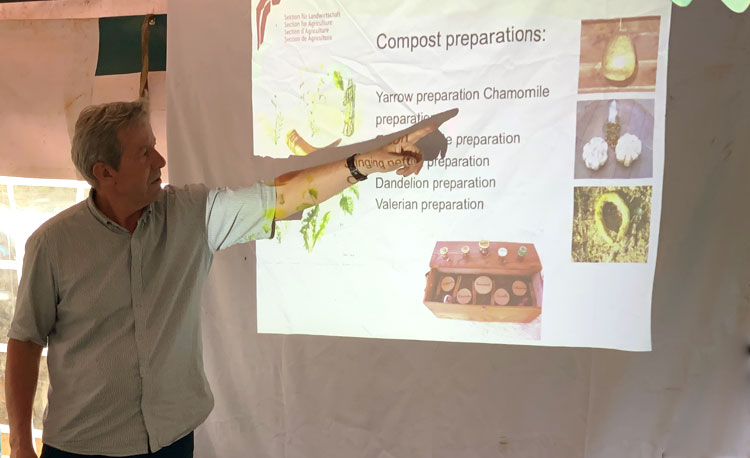
Technical exchange on biodynamic compost preparations
What challenges do you see in implementing biodynamic agriculture in Kenya?
Ueli: "One challenge is certainly that many approaches come from a different context. You cannot simply transfer them one-to-one to Kenya. Adaptations are needed to the climate, the available materials and the cultural conditions. Even the difference between Kenyan mixed agroforestry systems and the predominantly field-based agriculture in Europe is significant. These are completely different systems. For me, the question is: Can something be implemented here? A new biodynamic world in an agroforestry context?
Another challenge is the preparations. Not everything needed to make the preparations is available in the same way as in Europe. If, for example, certain plants for the preparations are not available, regional solutions are needed. Solutions and alternatives have to be found that work locally. And that is exactly right. The aim is not to impose a model, but to develop it individually within the respective cultural and climatic context."
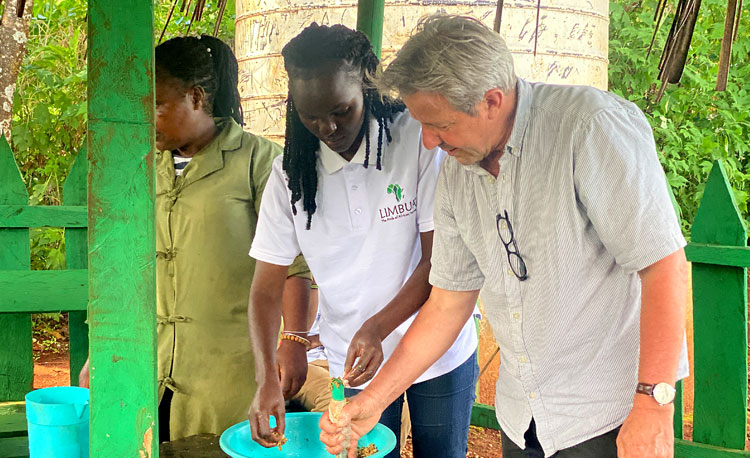
Making biodynamic preparations with the LIMBUA team
You also got to know LIMBUA's value chain. Were there any particular impressions?
Ueli: "One point that stood out to me was the way resources are handled. There is a clear effort to recycle, meaning to bring production residues back into cycles. For example, organic residues from macadamia, avocado and mango production are used to make organic compost. In addition, macadamia shells left after cracking are used to generate heat and electricity.
At LIMBUA, there is an attitude of: what is available is also used further. Nothing is quickly treated as waste. And that is more than efficiency. It also has to do with mindfulness. How do I handle the products? What responsibility do I have as a company?"
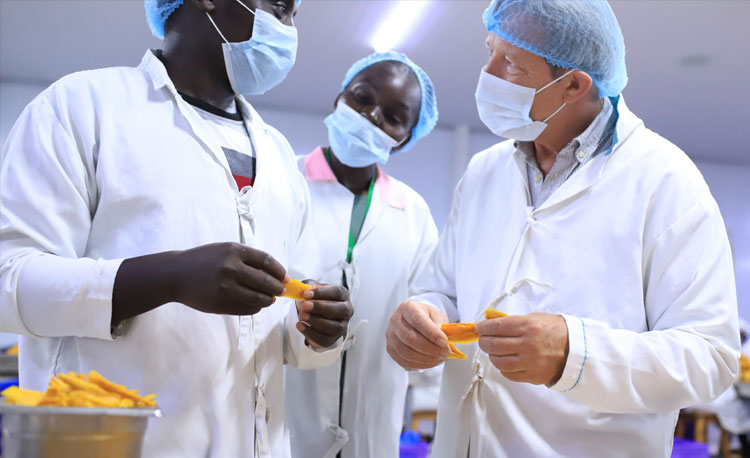
Insight into mango processing
Looking at the overall picture, what is your conclusion?
Ueli: "What impressed me was that the holistic idea does not stop at agriculture. The principles extend into the organization, into collaboration and into the way decisions are made. For example, teams are encouraged to experiment and think creatively. Employees are given space to take responsibility. Proactive, hands-on engagement is expressly welcomed. This releases potential and energy.
You can sense that the company was founded with a clear connection to people and nature. Business is not viewed in isolation, but in relation to people and ecological responsibility. LIMBUA is a for-profit social business carried by many shoulders.
And at the same time, it works economically. That's the key."


