


What does organic farming mean when production does not take place on one large monoculture farm, but across thousands of diversified farms managed by smallholder families?
This question was at the heart of LIMBUA’s contribution to the Ecocert Certification Symposium held in Nairobi in August. Ecocert South Africa brought together representatives from the organic sector to exchange experiences and perspectives on farming and certification.
LIMBUA was invited to speak at the symposium and shared insights from working with a network of thousands of organic smallholder farmers. Under the title “Organic Challenges and Opportunities in Practice”, the focus was deliberately not only on standards on paper, but on what it takes to implement them in everyday farming practice.
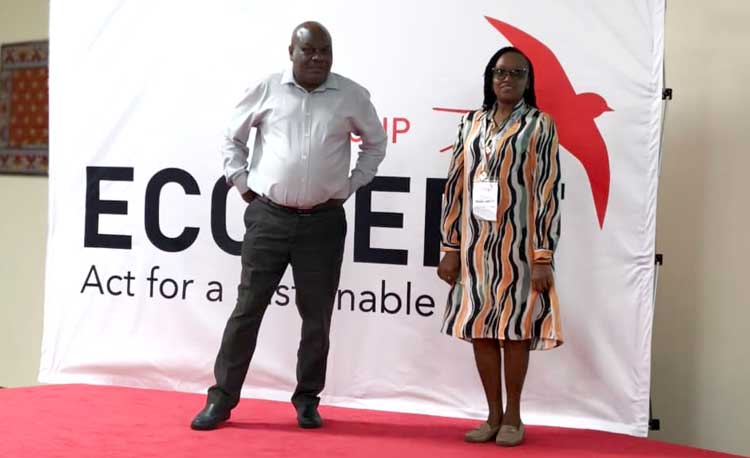
Peter Wangara and Abigail Birech presented the challenges and opportunities of organic farming
Starting point: organic farming across more than 9,000 individual farms
To understand the challenges, it is important to first understand how LIMBUA works: The macadamia nuts, avocados and mangoes we process are not grown on one large farm. They come from thousands of smallholder farmers we work with, each managing their own small, diversified farm.
A large monoculture farm would be easier to organise in many respects. Farming practices could be defined uniformly across the entire area. The use of agricultural inputs could be managed centrally, and inspections and documentation would take place within a single farming operation.
We provide the structures required for this and also cover the certification costs for all smallholder farmers. This involves an extensive Internal Control System: each of our more than 9,000 organic farmers undergoes at least one unannounced internal inspection every year. In addition, external auditors inspect a selection of farms annually.
We have deliberately chosen this considerably more complex approach because agricultural production and the value it creates should not be concentrated in one large operation and among only a few people. Instead, LIMBUA’s model is designed to enable as many people in the region as possible to participate in local value creation.
At the same time, this is precisely where some of the challenges we discussed at the Ecocert Symposium arise. Organic farming should not only work on a large farm, but also on small, independent farms with different crops and different conditions.
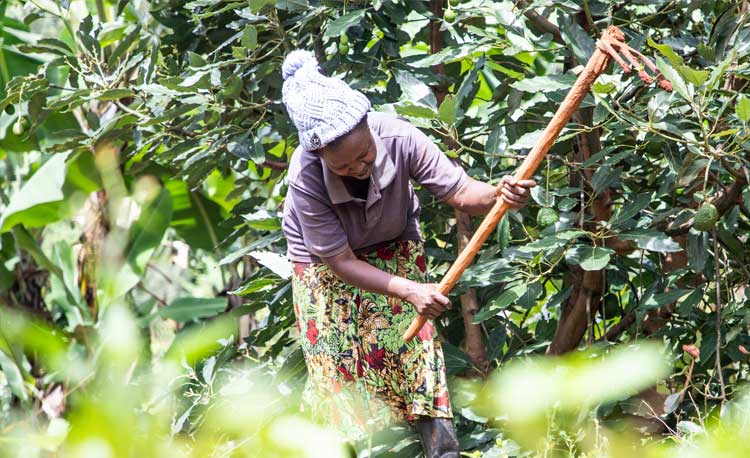
A LIMBUA smallholder farmer working on her diversified organic farm
One farm, many interests
A typical smallholder farm in the LIMBUA network is not a monoculture. On usually just 0.4 to 0.8 hectares, different crops and trees grow alongside one another. In addition to macadamia, these may include maize, coffee or tea, as well as vegetables and food crops for the family. This diversity is intentional: it reduces dependence on a single crop and can provide food and income at different times of the year.
For organic certification, however, this makes the situation considerably more complex. A farmer may, for example, sell coffee to another buyer and receive fertilisers or crop protection products from that buyer. If an input that is not permitted in organic farming is used, it can affect the organic status of the entire farm. At the same time, other buyers may have their own production requirements that are not always compatible with organic standards. For example, another buyer may require the use of certain inputs for coffee that are not permitted under organic standards. This means that different requirements and economic interests can come together on a single smallholder farm.
The development of LIMBUA’s product portfolio shows how this challenge can also create opportunities. While we initially purchased only organic macadamia from smallholder farmers, avocados and mangoes were already growing on many of these diversified farms. Today, all three crops are purchased and processed directly at our local production facilities. For people in the region, this means that more of their produce can access an organic market, creating additional sales opportunities and strengthening the economic resilience of diversified farms.
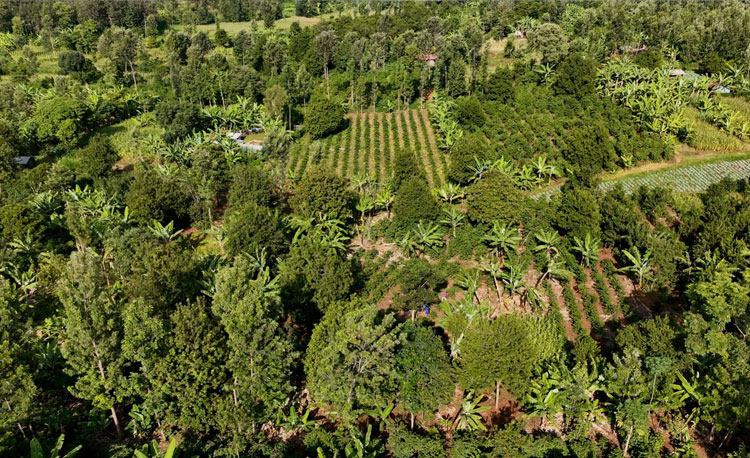
Smallholder agroforestry system in the Mount Kenya region: different crops grow together on the same farm
Limited access to suitable organic inputs
Another challenge becomes particularly tangible when a specific problem arises: what can smallholder farmers use, for example, when a crop is affected by pests?
The range of approved organic inputs available in Kenya is still limited, particularly for pest management. At the same time, there is a wealth of local knowledge. Smallholder farmers traditionally prepare plant-based treatments using pepper or other locally available plants and herbs, for example. But in certified organic farming, “natural” does not automatically mean “approved”. These preparations must also comply with the requirements of the respective organic standards.
In addition, conventional agricultural inputs are sometimes subsidised through government programmes, making them more readily available. An organic farmer may therefore face a situation in which a conventional solution is inexpensive and immediately accessible, while a suitable and approved organic alternative is more difficult to obtain.
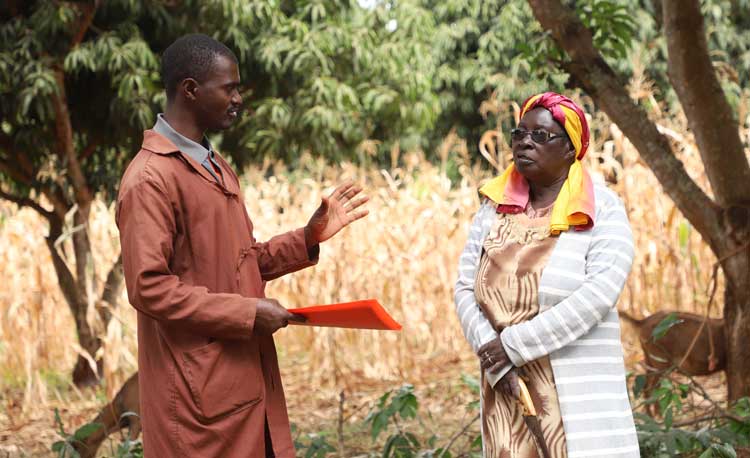
Field Officers support smallholder farmers in implementing organic requirements on their farms
This illustrates an important point: successful organic farming does not depend solely on which inputs are permitted or prohibited. Smallholder farmers need solutions that are actually available and practical under local conditions.
One opportunity therefore lies in developing suitable organic inputs locally. Traditional knowledge can also play a role. Plant-based methods should be documented and promising approaches scientifically investigated so that they may eventually become recognised solutions for certified organic farming.
EU organic requirements: when certification becomes a major organisational undertaking
What ultimately appears on a finished product as an organic label involves an enormous organisational effort in a smallholder network such as LIMBUA’s. Every additional requirement does not affect just one farm; it has to be implemented and documented in a traceable way across several thousand farms. For smallholder farmers themselves, certification also means additional administrative tasks alongside their daily work on the farm.
Under the current EU organic regulations, the requirements for large producer networks have become considerably more extensive. The LIMBUA network has therefore been organised into regional groups with their own representative structures.

EU organic requirements involve a significant administrative workload
The sheer volume of information involved illustrates what this means in practice. Records must be maintained for every farm, including information on farming practices and the inputs used. Harvest volumes must be documented and clearly attributed. What may still seem manageable for a single farm multiplies into a substantial administrative workload across a network of this size.
To manage these requirements, we have significantly expanded our human resources. Agronomists support smallholder farmers in implementing organic requirements. They are joined by Field Officers and ICS Officers, as well as employees who manage large volumes of data and ensure traceability from purchasing through processing to export.
This also creates skilled jobs in rural areas. However, the human and financial resources required remain a major challenge. LIMBUA is able to provide these structures and also covers the certification costs for several thousand


