


In October 2024, Rapunzel founder Joseph Wilhelm and his team travelled to Kenya: Together they visited the LIMBUA facilities to experience the production of their organic products directly on site. Since 1974, Rapunzel Naturkost has been active in the organic food industry and works with direct, long-term supplier relationships under defined certification requirements. As a long-standing partner in the “HAND-IN-HAND” program, we have a close relationship with Rapunzel based on organic quality and the defined requirements of the HAND-IN-HAND program.
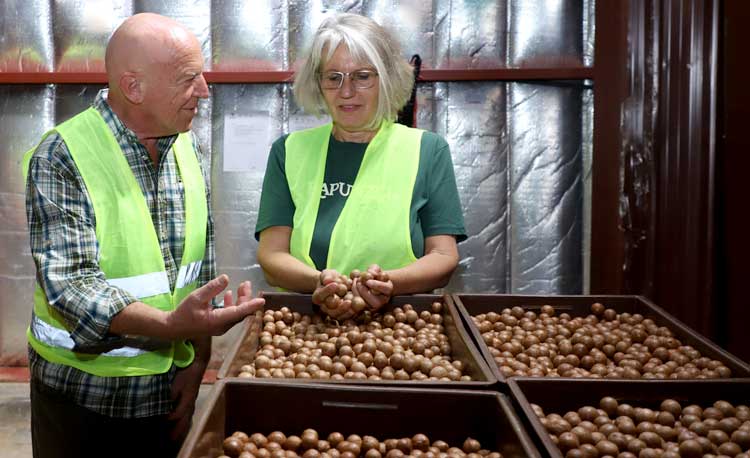
Rapunzel Naturkost founder Joseph Wilhelm and managing director Margarethe Epple explore the macadamia nuts at their origin
During the two-day stay, the guests had the opportunity to immerse themselves in the world of our organic production and to see the processing of macadamia nuts and coffee as the basis of their products on site.
About Rapunzel Naturkost
- Rapunzel Naturkost is headquartered in Legau, Germany, and employs today over 500 people. The company is one of the largest and most renowned organic food manufacturers in Europe.
- The Rapunzel product range includes over 550 organic vegetarian products. These include nuts, dried fruit, oils, cereals, chocolate, coffee and more. Many of these products are produced in cooperation with smallholder farmers worldwide.
- Since 1992, Rapunzel’s “HAND-IN-HAND” program has provided the framework for direct, long-term trading relationships with certified partners in accordance with defined organic and social criteria. More than 130 Rapunzel products today carry the HAND-IN-HAND seal, including LIMBUA products.
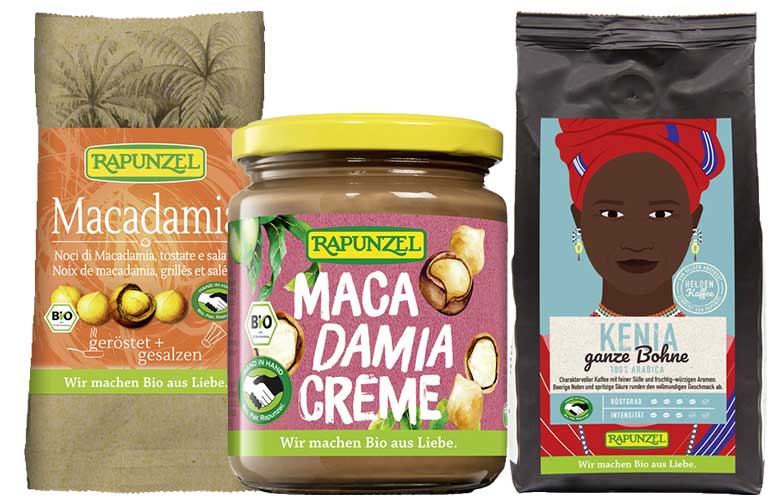
Rapunzel Naturkost products with LIMBUA organic macadamia nuts and organic coffee
The people behind Rapunzel Naturkost products: encounters that touch
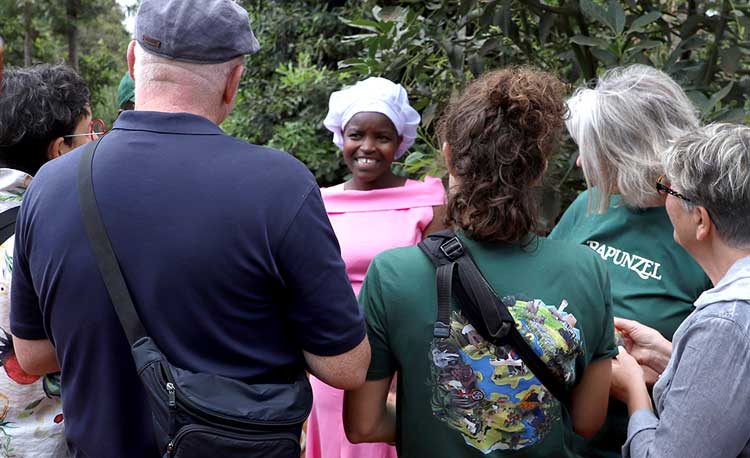
An exciting moment: the Rapunzel team meets Purity, whom they previously only knew from the photo on the product packaging
One of the personalities is Purity Karimi Muriithi: she has been a registered LIMBUA smallholder since 2013 and is also employed at our Kithungururu production site in the nut-cracking department. In 2024, she was one of the best nut-crackers at LIMBUA, demonstrating that she has mastered the craft with skill and speed.During the warm encounter, Purity saw the Rapunzel products with her photo for the first time. The meeting was very touching for both the German visitors and the Kenyans and offered a unique opportunity for intercultural exchange.
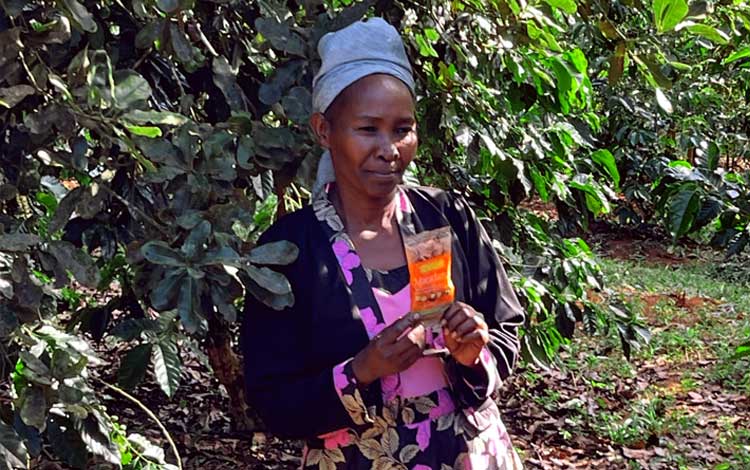
Macadamia and coffee farmer Mary Gicovi hosted the Rapunzel team at her farm
Another LIMBUA face for Rapunzel products is smallholder Mary Wanjiru, who has been registered since 2014. Mary and her husband are full-time farmers and live solely from the income they generate from their organic farm, which produces macadamia nuts, among other produce. According to Mary, the income from farming has helped her contribute to the education of her four children – one child has already graduated from university, two others are still studying there and one is in the final year of high school.
Since Mary Wanjiru was unable to receive a formal education herself, she is doing everything she can to invest in her children's education. As soon as they graduate, she plans to invest in her farm and build a new house. Mary’s story provides a personal insight into the importance of agricultural income for her family and particularly for her children’s education.
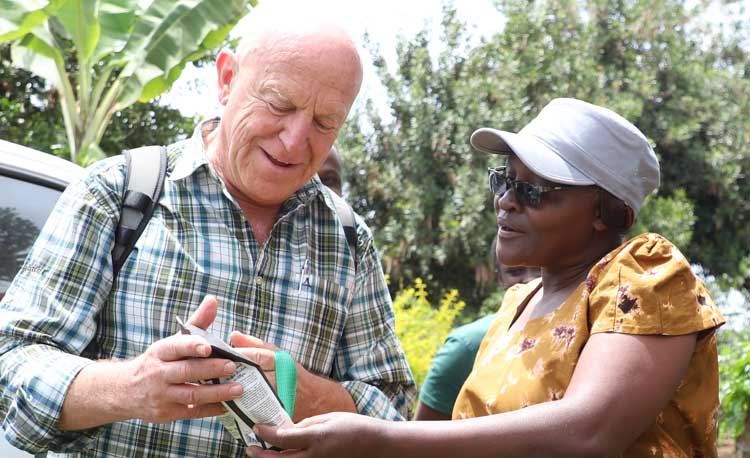
Joseph Wilhelm shows LIMBUA smallholder farmer Mary Wanjiru the roasted organic coffee
For both Mary and Purity, it was an almost surreal but very joyful experience to hold the products with their photos as LIMBUA ambassadors in their hands.
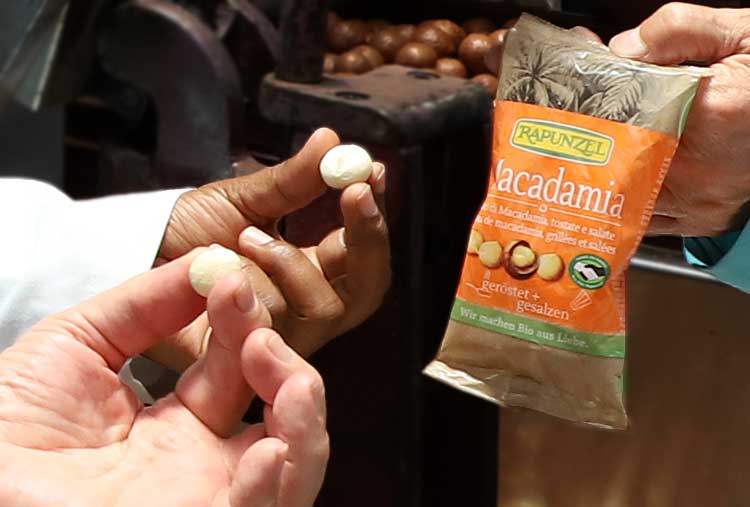
While they know the organic coffee beans from their farms in raw form, they now experienced the coffee roasted by Rapunzel for the first time. They also only know macadamia nuts raw and fresh from the tree. It was therefore particularly exciting for them to taste the macadamias from their farms, processed as cream and roasted and salted nuts. The sweet macadamia cream in particular was a completely new experience: at first it tasted very unusual by Kenyan standards, but they loved the nutty and creamy flavor.
- Although Kenya is a major coffee-producing country, most Kenyans prefer tea as their beverage of choice. People barely drink coffee on a daily basis in Kenya, unlike in Germany.
- Europeans have a sweet tooth compared to Kenyans and love sugary foods such as chocolate, spreads and sweet pastries. In the highlands of Kenya, fruit is the preferred snack. Accordingly, European products are very sweet for most Kenyans because they are not accustomed to the taste.
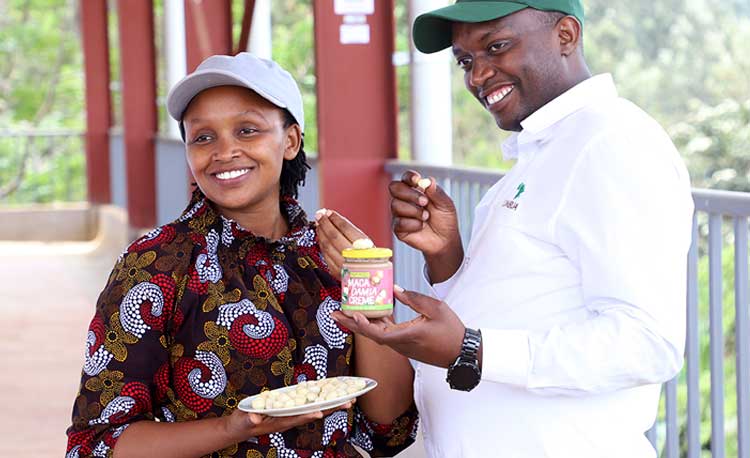
From shell to kernel: first experience cracking macadamias
The Rapunzel Naturkost visitors were suitably impressed by the specially developed hand-cracking tools and the care required to crack macadamias manually. It was their first time witnessing the processing of our supplied products.
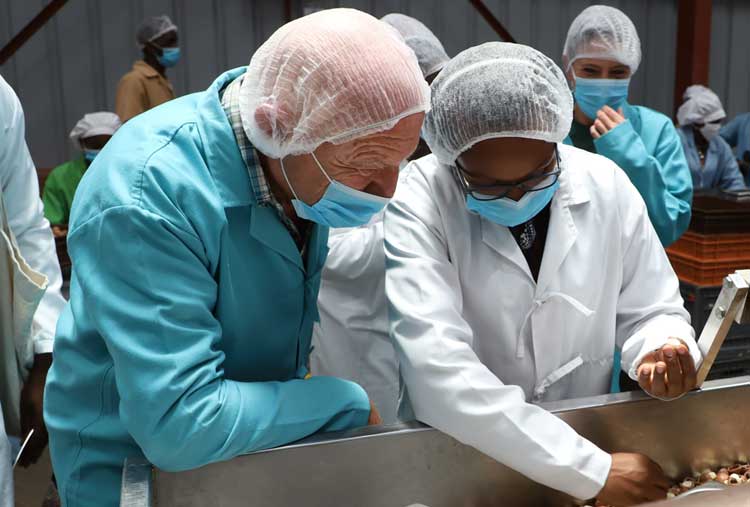
The art of macadamia cracking requires some practice
In addition to macadamia nuts, we were also proud to offer our guests our organic avocado oil and dried mangoes from our own production: other organic products that we purchase from our contract farmers in the region.
Cycles within the Value Chain
We are constantly working to create cycles within our value chain, extending from cultivation in the fields to processing at our production sites. One characteristic of this approach is the further use of organic by-products from processing. Residual materials from one process are used as raw materials for other applications, creating cycles between different production and agricultural activities. For example, the Rapunzel team visited the large-scale production of organic compost from production waste at our site in Ena, which in turn is supplied to the contract farmers for their farms.
Our newly implemented project with Omnivore Recycling was also examined. The responsible team explained the tested process in which organic production waste is converted into protein-rich animal feed for smallholder farmers’ livestock with the help of insect larvae.
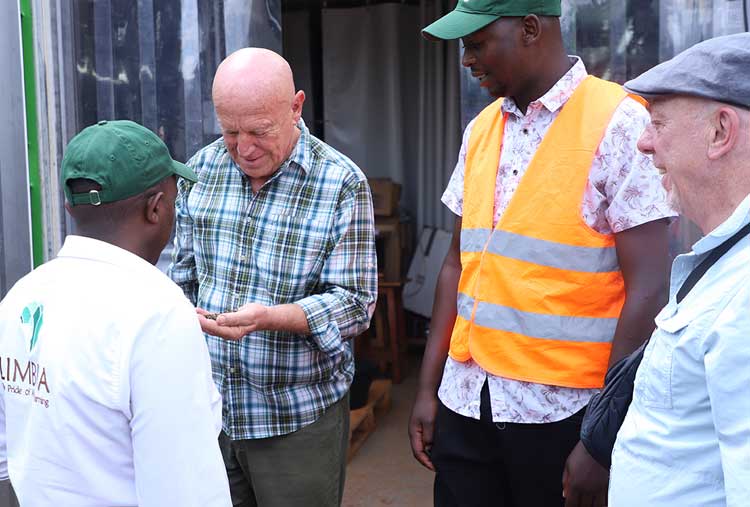
Waste recycling in a circular economy with insect larvae – the new pilot project
Afterwards, it was a great pleasure for Joseph Wilhelm, as a keen gardener, to be able to plant a young macadamia tree in the Kenyan soil with his own hands. The tree seedlings are also raised in our own tree nursery and distributed to local smallholder farmers. There, they can be integrated into mixed farming systems and contribute to expanding or renewing the existing tree populations.
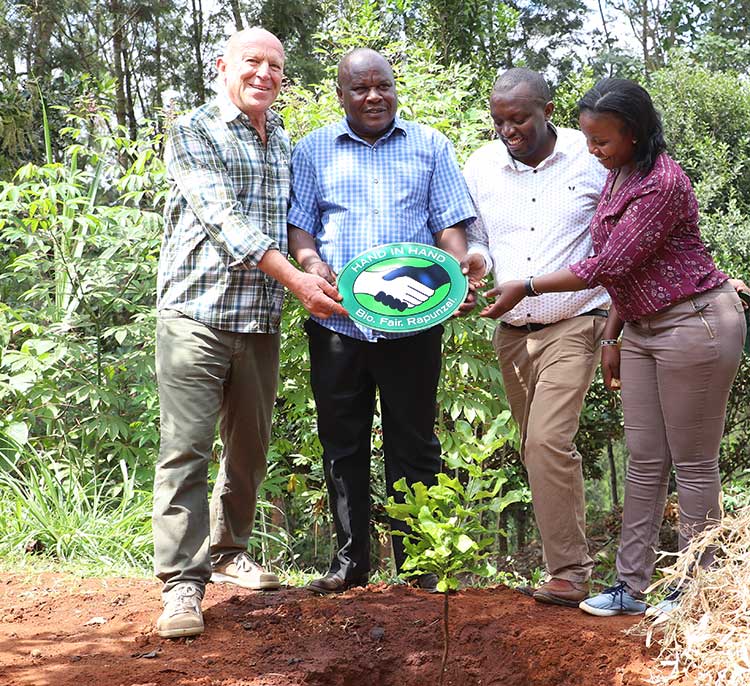
Joseph Wilhelm next to LIMBUA director Peter Wangara (left) after planting a macadamia tree
Documentation with a system
From the very beginning, we work with digital systems: from recording the harvest to purchasing and production. The basis for this is a software solution developed in-house that is tailored to the needs of LIMBUA. However, even in the digital age, we cannot do without paper entirely, because each of our contract smallholder farmers has their own physical file. This file is used to manage important information such as the contract, sales records, training certificates and daily records of agricultural activities and the inputs used on the farm. Of course, a digital version of each of these thousands of files is also available. This is how we ensure the greatest possible security and transparency in tracking.
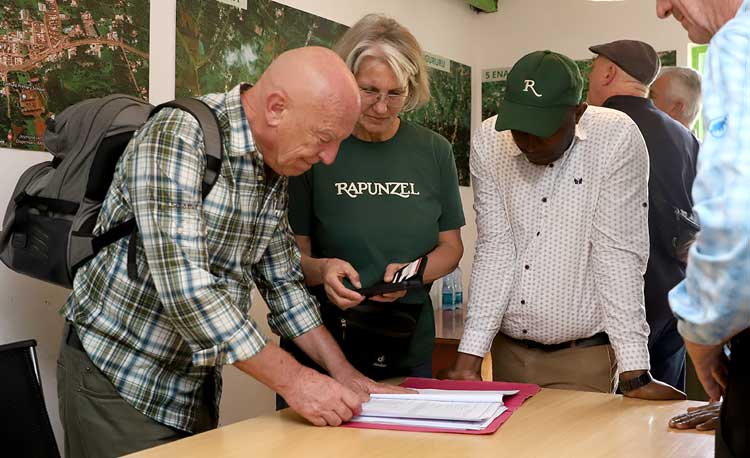
Jospeh Wilhelm inspects the file of a LIMBUA contract farmer
A successful exchange and outlook
The visit of Rapunzel Naturkost was more than just a trip to the origins of their products; it provided direct insights into organic agriculture and the people behind Rapunzel products. We look forward to continuing our cooperation with regional smallholder farmers within the externally certified HAND-IN-HAND program. Organic quality, direct sourcing and long-term supplier relationships remain the basis of our partnership and future projects.
Thank you for the visit, Joseph Wilhelm and team!
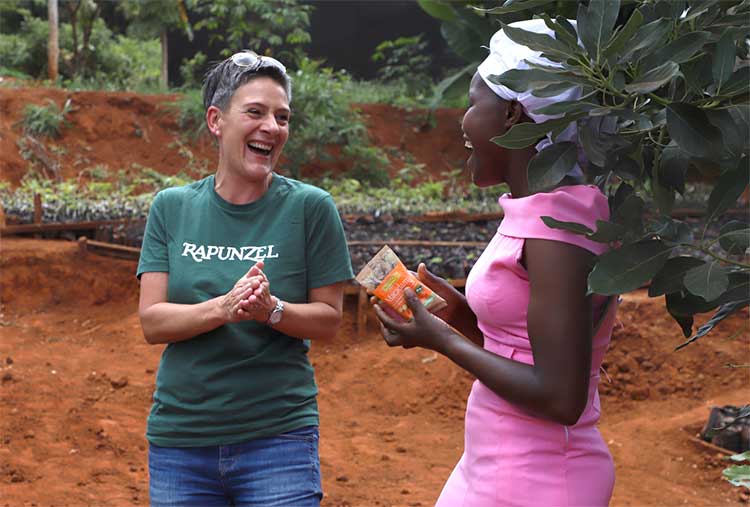
Sigrid Barry (head of Rapunzel Naturkost product management) in conversation with Purity


